Structure Functions
The lumped Foster- and Cauer-ladders used so far can be viewed as discrete approximations of a one-dimensional distributed RC line. This section shows how classical transmission-line theory maps onto thermal structure functions and how the cumulative and differential structure functions emerge naturally for non-uniform RC lines.
Transmission-Line Basics
A transmission line is a distributed two-port: its series impedance density \(z(x)\) and shunt admittance density \(y(x)\) are smeared continuously along the spatial coordinate \(x\).
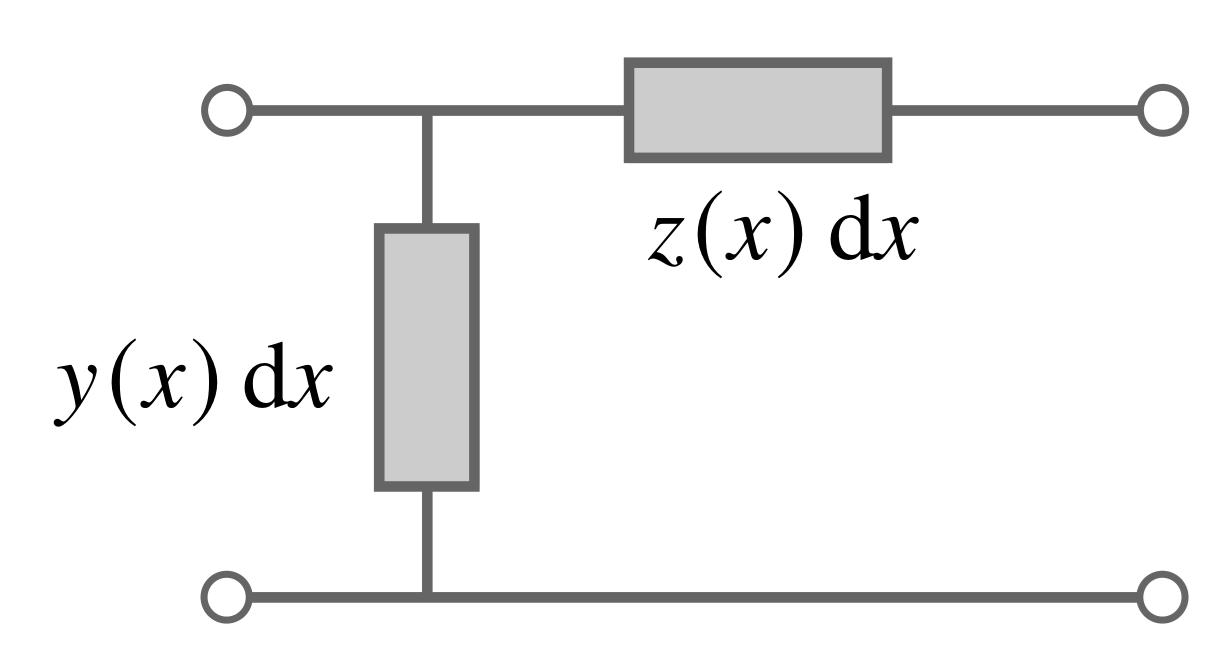
Fig. 3 Infinitesimal element of a general transmission line.
For an electrical wire
with \(s\) the complex Laplace variable. The Telegrapher equation
has the general solution
Here \(\alpha\) describes attenuation, \(\beta\) the phase shift, and
is the characteristic impedance. Driving a load \(Z_L\) through a length \(\Delta x\) gives
Uniform RC Line
For purely diffusive heat flow the electrical analogue keeps resistance in series and capacitance in shunt:
On a uniform line the local relations are
which combine to the heat equation
Injecting a charge \(Q\) at \(x=0\) gives
identical in shape to a thermal Green’s function.
Non-Uniform RC Line ⇔ Structure Function
Real devices do not possess constant material properties; both resistance density \(r(x)\) and capacitance density \(c(x)\) vary along the heat path. Define the cumulative quantities
These are exactly the axes of the cumulative structure function obtained from the Cauer ladder in network identification by deconvolution.
Differential and cumulative forms
Differential structure function
(47)\[\sigma\!\bigl(R_\Sigma(x)\bigr)= \frac{c(x)}{r(x)}.\]It equals the ratio of local densities expressed against cumulative resistance.
Cumulative structure function Also called the Protonotarios–Wing function,
(48)\[C_\Sigma(R_\Sigma)= \int_{0}^{R_\Sigma}\sigma(R'_\Sigma)\,\mathrm{d}R'_\Sigma \;=\; \int_{0}^{x(R_\Sigma)} c(x)\,\mathrm{d}x.\]
Voltage (temperature) evolution
With spatially varying densities the local balance becomes
In cumulative-resistance coordinates
A closed-form solution is known only for special profiles (\(\sigma=\text{const.}\) recovers the uniform line), but the equation underlies structure-function analysis: the measured pair \(\bigl(R_\Sigma,C_\Sigma\bigr)\) summarises all one-dimensional non-uniform RC lines that replicate the same driving-point thermal behaviour.
Relation to NID workflow
NID converts the step response to a Foster ladder (time-constant spectrum).
Foster → Cauer transformation produces a series RC ladder whose running sums reproduce \(R_\Sigma\) and \(C_\Sigma\).
Plotting \(C_\Sigma(R_\Sigma)\) yields the cumulative structure function; its slope is the differential structure function \(\sigma\).
Hence the structure function is nothing else than the physical picture of heat flow through a non-uniform RC line.